








The Complete Path of Exile 2 Currency List—Uses, Values & Pro Tips
I still remember the exact moment I threw away 200 Divine Orbs.
It was week three of a new POE2 league. I had just finished the campaign and moved into maps. My stash was overflowing with currency I'd collected—Alchemy Orbs, Chaos Orbs, even a few Exalted Orbs I was saving for something special. And then there were the Divine Orbs. I had 12 of them, and I had absolutely no idea what they were for.
So I did what any new player would do. I right-clicked one, clicked on a random piece of gear, and watched the modifiers change slightly. Huh, interesting. I did it again. And again. By the time a friend messaged me screaming "WHAT ARE YOU DOING," I had wasted 8 Divine Orbs on equipment I replaced the next day.
That was three leagues ago. I've learned a lot since then.
This guide isn't just a list of POE2 currency items—you can get that anywhere. This is the list I wish someone had handed me on day one, complete with the mistakes I made, the values I misunderstood, and the strategies that finally helped me stop wasting and start building real wealth.
Why Currency in POE2 Is Nothing Like Other Games
Here's the first thing that tripped me up: there is no gold.
In World of Warcraft, you kill a boar, it drops copper coins. In Diablo, you pick up gold piles. Simple. In Path of Exile 2, you kill a monster, and it drops... a scroll that identifies items. Or an orb that changes socket colors. Or a rare item that could fund your next five builds if you don't accidentally use it on the wrong thing.
Every currency item is also a crafting item. That means every time you use one, you're making a choice: use it now to improve your gear, or save it to trade for something better later. And if you don't know what each one does, you're going to make the same mistakes I did.
Let me walk you through each one, from the scrolls you'll see in act one to the mirrors you'll probably never find—and what I learned about each the hard way.
The Scrolls: My Early Game Ignorance
Scroll of Wisdom
What it does: Identifies magic, rare, and unique items.
What I did wrong: For my first two weeks playing POE, I didn't know you could buy these from vendors. I ran out constantly and had to leave maps early because I couldn't identify drops. I even skipped picking up rares because "I don't have scrolls."
What I learned: Always keep 20-30 in your inventory. When you run low, buy a stack from any vendor for a few scroll fragments. It costs almost nothing and saves so much frustration.
Portal Scroll
What it does: Opens a portal back to town.
What I did wrong: I used these every time my inventory filled up. Then I'd run back into the map through the same portal, clear a few more packs, and use another scroll. I burned through dozens this way.
What I learned: One portal scroll lasts the entire instance. You can go back and forth through the same portal as many times as you want until the map closes. I still cringe thinking about all those wasted scrolls.
The Fundamentals: Where I Started Learning
Orb of Transmutation
What it does: Turns a normal (white) item into a magic (blue) item with 1-2 modifiers.
What I did wrong: I used these on every white item I found, hoping to get something good. My stash filled with garbage magic items I never used.
What I learned: Transmutes are for one thing: creating bases for further crafting. If you want a specific base type with specific modifiers, you transmute it, then augment, then regal, etc. Just transmuting random items is a waste.
Orb of Augmentation
What it does: Adds a second modifier to a magic item that only has one.
What I did wrong: I didn't understand why this existed. "Why would I add a random modifier when I could just find a better item?"
What I learned: Augmentations are essential for targeted crafting. When you have a magic item with one good modifier, an Augmentation gives you a chance to add a second good one. This is how good items are born.
Orb of Alteration
What it does: Re-rolls all modifiers on a magic item.
What I did wrong: I hoarded these because "they might be valuable later." Later came, and I had 400 Alterations I never used.
What I learned: Alterations are for rolling specific magic-item combinations. Want a wand with +1 to fire spells and cast speed? You'll burn through Alterations until you get it. They're meant to be used, not saved.
Orb of Alchemy
What it does: Turns a normal item directly into a rare (yellow) item with 4-6 random modifiers.
What I did wrong: I used my first Alchemy on a level 12 helmet because "rare item good." I replaced it 20 minutes later.
What I learned: Alchemy Orbs are for high-level bases. Save them for item level 80+ gear. Using an Alch on leveling gear is like using a $100 bill to start a campfire—it works, but why would you?
My biggest Alchemy mistake: In maps, I once Alched a white base, got a decent item, and equipped it immediately. Later I realized I could have sold that base to another player for multiple Chaos Orbs. The base itself had value—I just didn't know it.
The Mid-Tier: Where I Started Getting Serious
Chaos Orb
What it does: Re-rolls all modifiers on a rare item.
What it's actually for: This is the dollar bill of POE2. Everything is priced in Chaos. You'll use them to trade, to re-roll items, and to measure wealth.
What I did wrong: I treated Chaos Orbs like crafting materials. "This item isn't perfect—let me Chaos it again!" I burned through 50 Chaos on a single piece of gear that I could have bought for 30.
What I learned: Chaos Orbs are currency first, crafting tools second. Before you Chaos an item, ask: could I buy something better for the same cost? Often the answer is yes.
Pro tip I wish I'd known: The "Chaos recipe" (selling a full set of rare items to a vendor) is a reliable way to generate Chaos early in a league. I ignored this for years and wondered why I was always poor.
Orb of Fusing
What it does: Re-rolls the number of linked sockets on an item.
What I did wrong: I tried to six-link my first end-game chest with about 40 Fusings. When it didn't work, I assumed the item was bugged.
What I learned: Six-linking an item takes hundreds of Fusings on average. Some players spend thousands. My 40 Fusings weren't even a serious attempt—they were a lottery ticket I didn't understand I was buying.
Chromatic Orb
What it does: Re-rolls socket colors.
What I did wrong: I spent Chromatics trying to get four red sockets on an item that could never roll four reds because of its stat requirements.
What I learned: Socket colors are weighted by the item's attribute requirements. Strength items roll red easier, Dexterity items roll green, Intelligence items roll blue. Before you spam Chromatics, check the item's base type and save yourself hundreds of orbs.
Jeweller's Orb
What it does: Re-rolls the number of sockets on an item.
What I did wrong: I used Jeweller's on items I was leveling with, trying to maximize sockets immediately. Waste after waste.
What I learned: Jeweller's are for end-game gear. Until you're in maps, just use whatever sockets drop. The orbs you save will fund real upgrades later.
The High-End: Where I Finally Got Smart
Divine Orb
What it does: Re-rolls the numerical values of modifiers on an item.
Remember those 8 Divine Orbs I wasted? Yeah. That still hurts.
What I learned: Divine Orbs are for min-maxing nearly perfect items. If your weapon has 180-220% increased damage and you roll 185%, a Divine might get you to 215%. That's worth it. If your item is garbage, a Divine just makes it differently garbage.
The rule I follow now: Only Divine an item if you'd be devastated to lose it. Otherwise, sell the Divine and buy something better.
Exalted Orb
What it does: Adds a new random modifier to a rare item with an open prefix or suffix.
What I did wrong: I Exalted a ring with three open modifiers, hoping for something good. I got "+5 to maximum life." That ring was worth less after the Exalt than before.
What I learned: Exalted Orbs are for finishing items that already have great modifiers. You Exalt when you have 3-4 perfect mods and want to gamble on one more. You never Exalt an item with empty slots hoping to fill them—that's how you get +5 life.
Vaal Orb
What it does: Corrupts an item with unpredictable results. Could improve it, could destroy it, could do nothing.
What I did wrong: I Vaaled a 6-link chest I'd saved for months to buy. It turned into a rare item with worse stats and I couldn't trade it anymore. I quit the league for a week.
What I learned: Vaal Orbs are for items you're willing to lose. Never Vaal your only good item. Never Vaal something you can't replace. The "corruption" tag is permanent—it can't be undone or modified further.
Mirror of Kalandra
What it does: Creates a mirrored copy of any non-corrupted item.
What I did wrong: Nothing, because in 10 years of playing, I've never found one. Most players never will.
What I learned: Mirrors are the stuff of legend. If you ever find one, do not use it. Do not trade it without understanding exactly what you're doing. A Mirror can fund multiple entire builds. It is the pinnacle of POE wealth.
The Mistakes That Taught Me the Most
Beyond individual currencies, I made systemic errors that cost me hundreds of orbs. Learn from these:
Crafting on the Wrong Bases
I spent 200 Chaos crafting on a item level 70 base. The resulting item was decent, but it could never roll the highest-tier modifiers because the base level was too low. A player with an ilvl 86 base could craft something strictly better.
The rule: Check the item level before you invest anything. Use the "alt" key to see ilvl. For end-game gear, you want ilvl 83+ for most modifier pools.
Not Using Trade
I crafted for months before I realized I could just buy what I needed. I'd spend 100 Chaos trying to roll a specific modifier when I could have bought the item for 30.
The rule: Before you craft, check if the item already exists on the trade site. Crafting is for when you need something specific that isn't available, or when you enjoy the gambling aspect.
Hoarding Everything
I had tabs full of currency I "might need someday." Someday came, and I had 500 Orbs of Alteration I never touched.
The rule: Use currency or convert it. Sitting on it does nothing. If you're not crafting, turn your Alterations into Chaos through trading. If you're not trading, use them to craft items to sell. Hoarded currency is dead currency.
Not Using a Loot Filter
I missed so many valuable drops because I didn't have a filter. Chaos Orbs on the ground look almost identical to trash items. I walked past dozens.
The rule: Install a loot filter on day one. FilterBlade is the standard. It highlights valuable currencies with big text and sounds so you never miss them.
How I Actually Use Currency Now
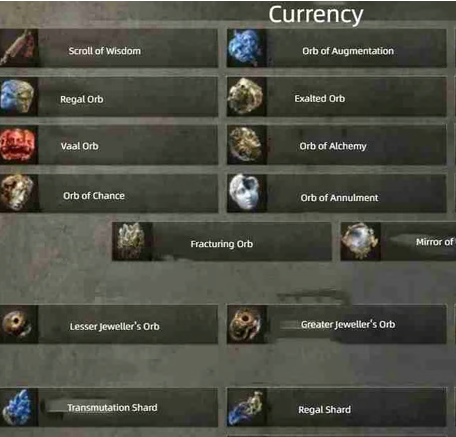
After years of mistakes, here's my current system:
Scrolls: Keep 20 of each in inventory. Rest in stash. Buy more from vendors when low.
Low-tier orbs (Transmute, Augment, Alteration): Use freely for early mapping and basic crafting. Convert excess to Chaos through trading if I have hundreds.
Mid-tier (Alchemy, Chaos): Chaos are my trading baseline. I keep a reserve of 50-100 for small purchases. Alchs I use on high-level bases only.
High-tier (Exalted, Divine): These are for targeted crafting and major trades. I never use an Exalted on an item worth less than several Exalted. I never Divine an item I wouldn't cry over losing.
Ultra-rare (Mirror): I'll let you know if I ever find one.